6 Module 6: Microbial Genome Sequencing
6.1 Background
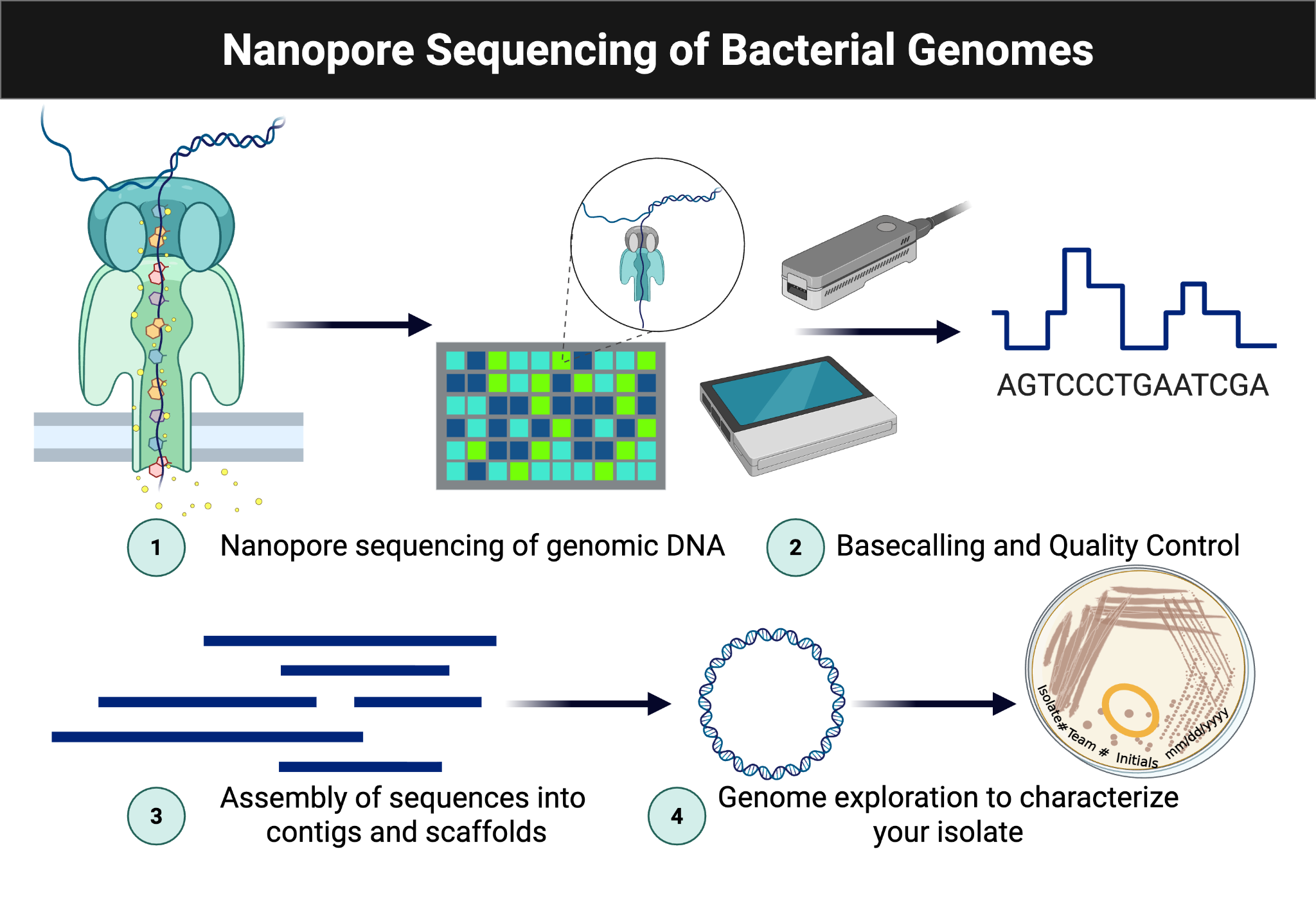
This module connects phenotype to genotype by sequencing the genome of the isolate. DNA is extracted using the NO-MISS workflow and analyzed with Oxford Nanopore sequencing and downstream genome assembly tools.
Figure Figure 6.1 summarizes the sequencing and downstream analysis pipeline from isolate DNA to annotated genome.
6.2 Criteria for Success
Successful completion requires participation in DNA isolation and sequencing preparation, collection of analyzable data, and a complete ELN entry.
6.3 Learning Outcomes
- List safety considerations for extracting DNA from microbial isolates. (CO 3, 4, 5) 🥼
- Explain the purpose of the reagents used for DNA extraction. (CO 3, 4, 5) 🥼
- Discuss the significance of high-molecular-weight DNA for sequencing. (CO 3, 4, 5) 🥼
- Practice extracting DNA from liquid cultures. (CO 3, 4, 5) 🥼
- Practice quantifying DNA using a Qubit fluorometer. (CO 3, 4, 5) 🥼
- Describe the purpose, methods, and preliminary results of your DNA extraction, quantification, and sequencing experiments. (CO 3, 2, 8,9) 📁
- Collect data from DNA extractions. (CO 6, 8) 📈
- Interpret DNA quantification and sequencing data. (CO 6, 7,8) 📈
- Revise the draft for your individual and group projects. (CO 3, 9) 🏅
- Analyze how this experiment contributes to your overall experimental goal. (CO 1) 🤔
6.4 Skills and Knowledge
Completing this module will help you develop and practice the following skills and knowledge, which you can include in your curriculum vitae.
  Skills: This module helps you practice the following essential skills for safe and effective lab work with microbial isolates. Additionally, you will learn to extract, sequence, and analyze bacterial DNA. After completing this lab, you will gain the following lab skills:
- Lab safety and proper personal protective equipment (PPE)
- Microbial DNA extraction and quantification
- Analysis of microbial DNA sequence data
  Knowledge: This module will also help you become familiar with the following important content in microbial genomics lab settings:
- Understanding PPE requirements for DNA isolation and purification from microbes.
- Familiarity with DNA extraction and quantification methods
- Understanding of Oxford Nanopore Technologies (ONT) DNA sequencing.
6.5 Procedures
6.5.1 Lab Safety
6.5.1.1 Before Lab
- Wear the correct PPE (lab coat, goggles, and gloves).
- Wipe the lab bench with 70% ethanol.
- Before working with microorganisms, carefully wipe pipettors with 70% ethanol.
6.5.1.2 During Lab
- Treat all tips as potential biohazards.
- Remove your PPE if you are leaving the lab (water/bio break).
- Discard samples and disposable lab items in the correct trash bins.
- Try to keep personal items (computers, phones, etc.) usage to a minimum.
6.5.1.3 After Lab
- Wipe your station with 70% alcohol.
- If you touched any personal items during the lab, wipe them with 70% ethanol before leaving.
- Dispose of gloves in the main biohazard waste container.
- Dispose of used petri dishes in the biohazard bin.
- All liquids containing bacteria must be poured into a beaker for bleach decontamination (can be found on the blue bench paper by this sink labeled “liquid”).
- Glass tubes can be placed into a beaker (on the blue bench paper by this sink, labeled “glass”).
- All bacterial growth plates can be thrown away in the biohazard trash.
- Return all reusable materials to our storage drawers.
- Wipe down all surfaces with ethanol.
- Remove PPE.
- Wash your hands.
6.5.2 Methods: What Was Prepared in Advance
- Start an overnight culture of your isolate in Tryptic Soy Broth (TSB, 2.5 mL per tube) by using a sterile loop to obtain one colony from an agar plate and inoculate TSB.
- Incubate with shaking at 30°C overnight.
- For general bacterial inputs, reconstitute the lysozyme in TE buffer to 10 mg/ml. We recommend preparing enzymes freshly on the day, as enzymatic activity reduces over time once reconstituted.
6.5.3 Methods: Day of the Lab
- We will follow the Nanopore-only Microbial Isolate Sequencing Solution (NO-MISS) associated extraction protocols.
- Obtain your liquid culture and spin down 1.0 mL of culture.
- In a fresh 1.5 mL Eppendorf DNA LoBind tube, centrifuge 1,000 µl at 12,000 x g for 1 minute.
- Remove the supernatant and resuspend the pellet in 100 µl TE buffer with 10 µl lysozyme.
- Incubate at 37°C for 10 minutes in a thermomixer at 500 RPM. If a thermomixer is unavailable, the reaction can be incubated stationary and agitated by gently flicking for 10 seconds every two minutes.
- Combine the following reagents with your sample in the 1.5 mL Eppendorf DNA LoBind tube, and mix by vortexing.
| Reagent | Volume |
|---|---|
| Proteinase K | 10 uL |
| RNase A | 3 uL |
| Total (w/ sample) | 113 uL |
- Vortexing your sample before adding the CTAB buffer allows the enzymes to fully mix with the bacterial cells, as the mixture can become viscous.
- Add 200 µl of CTAB buffer and mix by vortexing. Extractions performed using the CTAB buffer improve sequencing health and output compared to using NEB Lysis Buffer from the Monarch Spin gDNA Extraction Kit.
- IMPORTANT: The full 30-minute incubation must be completed to ensure the proteinase and RNase activity occurs, regardless of turbidity.
- Incubate at 56°C for 30 minutes in a thermomixer at 1,000 RPM.
Note: Depending on the bacterial input, the solution may become fully transparent or may remain hazy.
INFO: The Monarch Spin gDNA Extraction Kit is used for gDNA extraction. The remainder of this method is written following the Genomic DNA Binding and Elution protocol with our recommended alterations.
- Preheat the Monarch® gDNA Elution Buffer to 60°C for later use.
- IMPORTANT: The ratio of binding buffer to lysate (2:1) is important for the column binding efficiency. We recommend taking through 200 µl of lysate for use with 400 µl of binding buffer per sample. To run more samples from the same isolate, the volumes can be increased in relation to the 2:1 ratio of buffer to lysate.
- Combine the following reagents in a clean 1.5 mL Eppendorf DNA LoBind tube:
| Reagent | Volume |
|---|---|
| Lysate from the previous step | 200 uL |
| Monarch® gDNA Binding Buffer | 400 uL |
| Total (w/ sample) | 600 uL |
Ensure the reaction is thoroughly mixed by pipetting until the liquid is homogeneous. Thorough mixing is essential to ensure the DNA binds properly to the column and to homogenise the CTAB and Monarch® gDNA Binding Buffer, which solidify on initial contact.
Transfer the reaction to a Monarch® Spin Column pre-inserted into a Monarch® collection tube, without touching the upper column area.
Close the tube and centrifuge for 3 minutes at 1,000 x g to bind the gDNA and then for 1 minute at maximum speed (>12,000 x g) to clear the membrane. Do not empty or remove the collection tube from the centrifuge when changing settings.
Remove the gDNA spin column from the collection tube and discard the tube with the flow-through.
Transfer the gDNA spin column to a new collection tube and add 500 µl Monarch® gDNA Wash Buffer.
- IMPORTANT: Do NOT vortex.
Close the collection tube and invert multiple times until the wash buffer reaches the cap.
Immediately centrifuge the collection tube for 1 minute at maximum speed (>12,000 x g). Remove the gDNA spin column from the collection tube to discard the flow-through.
Re-insert the gDNA spin column into the collection tube, add 500 µl gDNA wash buffer, and close the tube.
Immediately centrifuge the collection tube for 1 minute at maximum speed (>12,000 x g). Remove the gDNA spin column from the collection tube to discard the flow-through.
After centrifugation, ensure there is no liquid in the gDNA spin column above or below the silica membrane. If there is liquid, repeat the centrifugation until all liquid is removed.
- IMPORTANT: Preheating the Monarch® gDNA Elution Buffer to 60°C is essential for maximum recovery of larger gDNA fragments.
Place the gDNA spin column in a DNase-free 1.5 mL microfuge tube and add 100 µl of preheated Monarch® gDNA Elution Buffer. Close the tube and incubate at room temperature for 1 minute.
TIP: If extractions are not yielding high enough concentrations of DNA for 200 ng per sample, less gDNA elution buffer can be run through the column to increase the concentration.
Note: Elution of less than 100 µl results in lower total yield, and elution of less than 50 µl is not recommended.
We recommend repeating the elution by passing 100 µl of eluate through the column once more.
Centrifuge for 1 minute at maximum speed (>12,000 x g) to elute the gDNA into the 1.5 mL microfuge tube. The gDNA spin column can be discarded.
Quantify 1 µl of eluted sample using a Qubit fluorometer.
Add 1 µl of eluted sample (DNA) to a Qubit tube with 199 µl of 1X High Sensitivity (HS) Assay mix.
Record the DNA concentration in your notes and on the tubes.
The expected yield is ~15-20 ng/µl per sample with a DNA Integrity Number (DIN) of 9.
Store at 4 or 20°C until use.
Genomic DNA quantification will be performed with a Qubit fluorometer.
Figure Figure 6.2 illustrates the Qubit measurement setup used to quantify extracted DNA prior to library preparation.
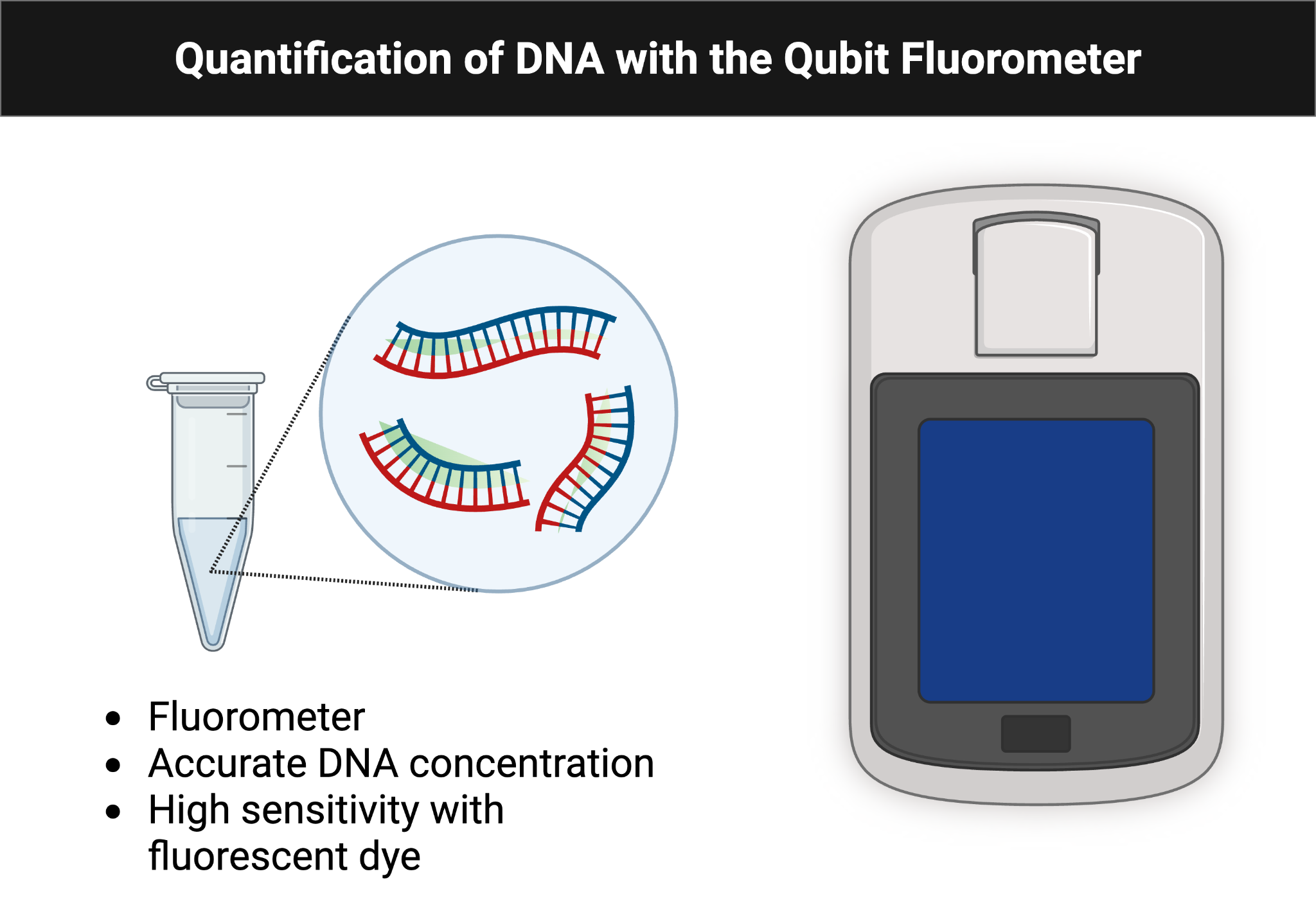
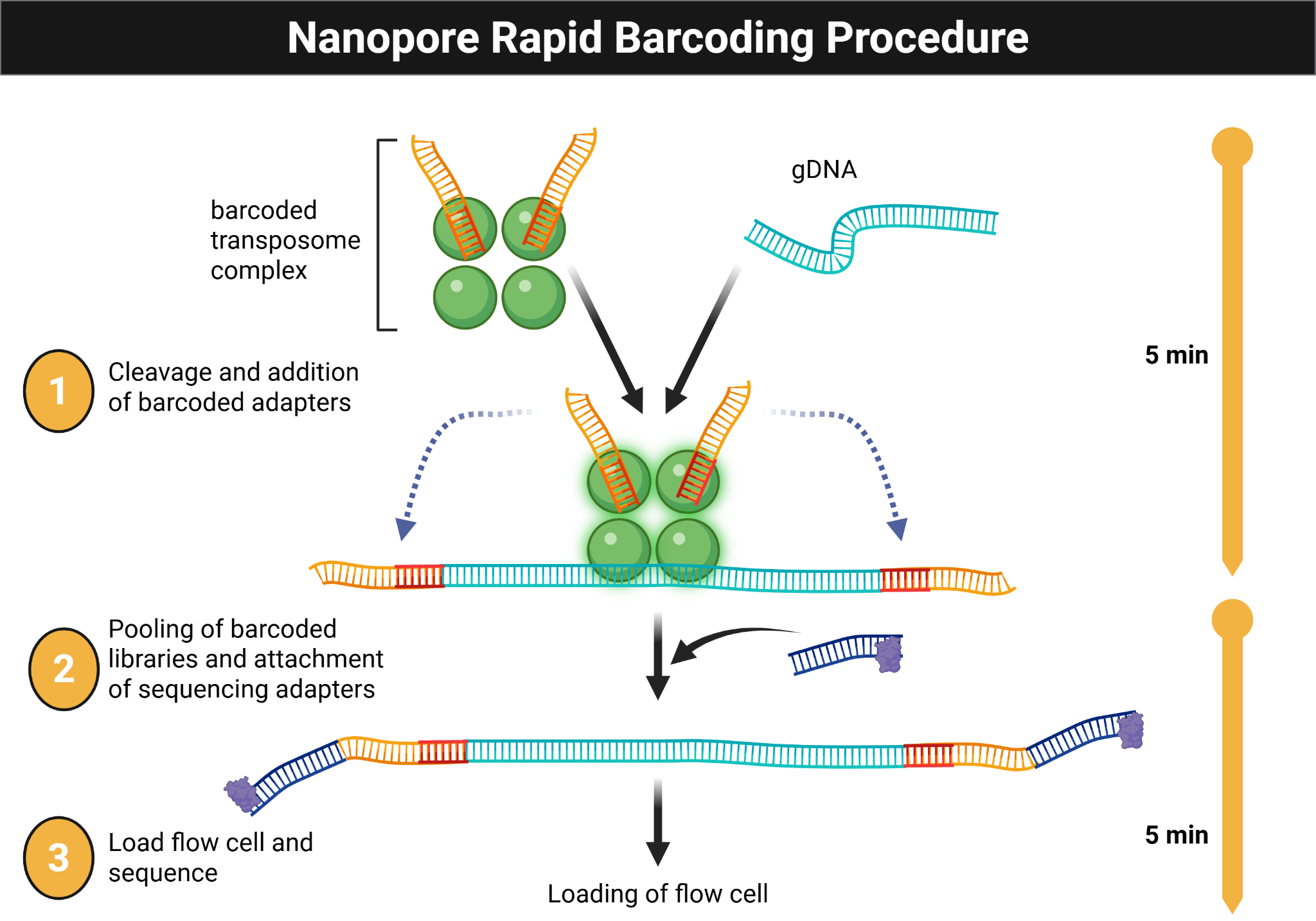
Figure Figure 6.3 summarizes the rapid barcoding library-preparation workflow used before sequencing.
6.5.4 Methods: Library Prep
- We will prepare our samples for sequencing by following the Nanopore-only Microbial Isolate Sequencing Solution (NO-MISS) from cell cultures using SQK-RBK114 (.24 or .96) protocol.
- Take 10 µl of your DNA and transfer it to a PCR tube to obtain at least 200 ng of DNA.
- Follow the protocol linked above.
6.5.5 Methods: Genome Analysis
Create a free BV-BRC.org account. Share your username with your instructors.
Access the sequences in our shared BV-BRC workspace.
Obtain concatenated sequences for your isolate from the shared workspace.
Follow the Comprehensive Genome Analysis Service tutorial: Comprehensive Genome Analysis (CGA) Service | BV-BRC.
Start a job to assemble and annotate your genome by
Indicating the file(s) for your long-read Nanopore sequences (single read)
Indicate the files for your paired Illumina sequences (paired reads). There should be R1 and R2 files for your isolate.
Leave the assembly parameters on auto
Submit the job.
Wait… ~30 min to overnight.
Create a free SeqHub account.
Upload the assembled genome FASTA file from BV-BRC.org Comprehensive Genome Analysis Service to annotate and explore in SeqHub.
6.6 Data/ Results
Paste a picture of any figures or images generated from your data:
Replace the note with your results.
6.7 Result Analysis
Discuss DNA yield, sample quality, and whether the sequencing-related results matched expectations. Include factors that may have affected DNA recovery and what you would change next time.
Replace the note with your result analysis.
6.8 Discussion
In which ways are microbial genome assembly and annotation tools beneficial for research? Think about what additional uses this information can have.
What other sequencing tools do you know? What makes nanopore sequencing different from others?
Identify at least one change made to the lab protocol, whether intentional or accidental (e.g., wrong amount of reagent used, contamination, etc). How did, or could, this change/accident impact your final results?
Replace the note with your discussion.