2 Module 2: Microbial Propagation
2.1 Overview
Weeks 2 and 3 focus on plate streaking, colony observation, and starting liquid cultures for later growth analysis.
2.2 Purpose
- Recover and propagate Delftia acidovorans from colonies.
- Observe colony morphology, streak plates, and start liquid cultures.
- Review safety procedures for working with live microbial isolates.
2.3 Learning Outcomes
- List the items needed to propagate microbes in liquid cultures and 96-well plates.
- Explain the stages of bacterial growth on a growth-curve graph.
- Describe defined, complex, selective, enriched, and differential media.
- Discuss the importance of controls.
- Practice inoculating and diluting liquid cultures.
- Describe the purpose, methods, and preliminary results of microbial growth experiments.
- Collect and interpret colony morphology and growth data.
- Create and use a team data management plan.
2.4 Skills and Knowledge
2.4.1 Skills
- Work safely with bacterial growth on agar plates.
- Document protocols and results clearly.
- Interpret colony morphology and growth in liquid TSB medium.
- Propagate bacteria in liquid culture.
2.4.2 Knowledge
- PPE for microbial work.
- Loop use, sterilization, and streaking methods.
- Propagation of microorganisms in solid and liquid media.
2.5 Task
Review the protocol before lab and work with your partner to complete the propagation tasks, document observations, and record changes to the procedure.
2.6 Criteria for Success
You should complete the solid- and liquid-media propagation tasks, collect observations that can be analyzed, and submit a complete ELN entry.
2.7 Background
Our lab experiments will use the bacterium Delftia acidovorans. Since we will work with environmental isolates that may be naturally antibiotic-resistant, we want to minimize exposure and contain any potential biohazards. We will work with several different isolates. Each group will characterize one isolate.
2.8 Procedures
2.8.1 Lab Safety
2.8.1.1 Before Lab
Note that we will be working with live microbial isolates today. Please follow all safety protocols and dispose of potentially biohazardous materials properly.
- Wear a lab coat, goggles, and gloves.
- Wipe the bench and pipettors with 70% ethanol.
2.8.1.2 During Lab
- Treat all tips as potential biohazards.
- Remove PPE when leaving the lab.
- Discard samples and disposables in the correct containers.
- Keep personal item use to a minimum.
2.8.1.3 After Lab
- Wipe the station with 70% ethanol.
- Decontaminate any personal items touched during lab.
- Dispose of gloves in the main biohazard container.
2.8.2 Methods: Observe Colony Morphology
- Place the plate on a bench that has been wiped with 70% ethanol
- Obtain a TSA plate with colonies of your isolate
- Observe colonies without opening the plate and record notes
- Photograph the plate using a black background if provided
- Share images with your partner and compare observations
2.8.3 Methods: Plate Streaking
Figure Figure 2.1 illustrates the transfer of a single colony to a fresh plate during the streaking workflow.
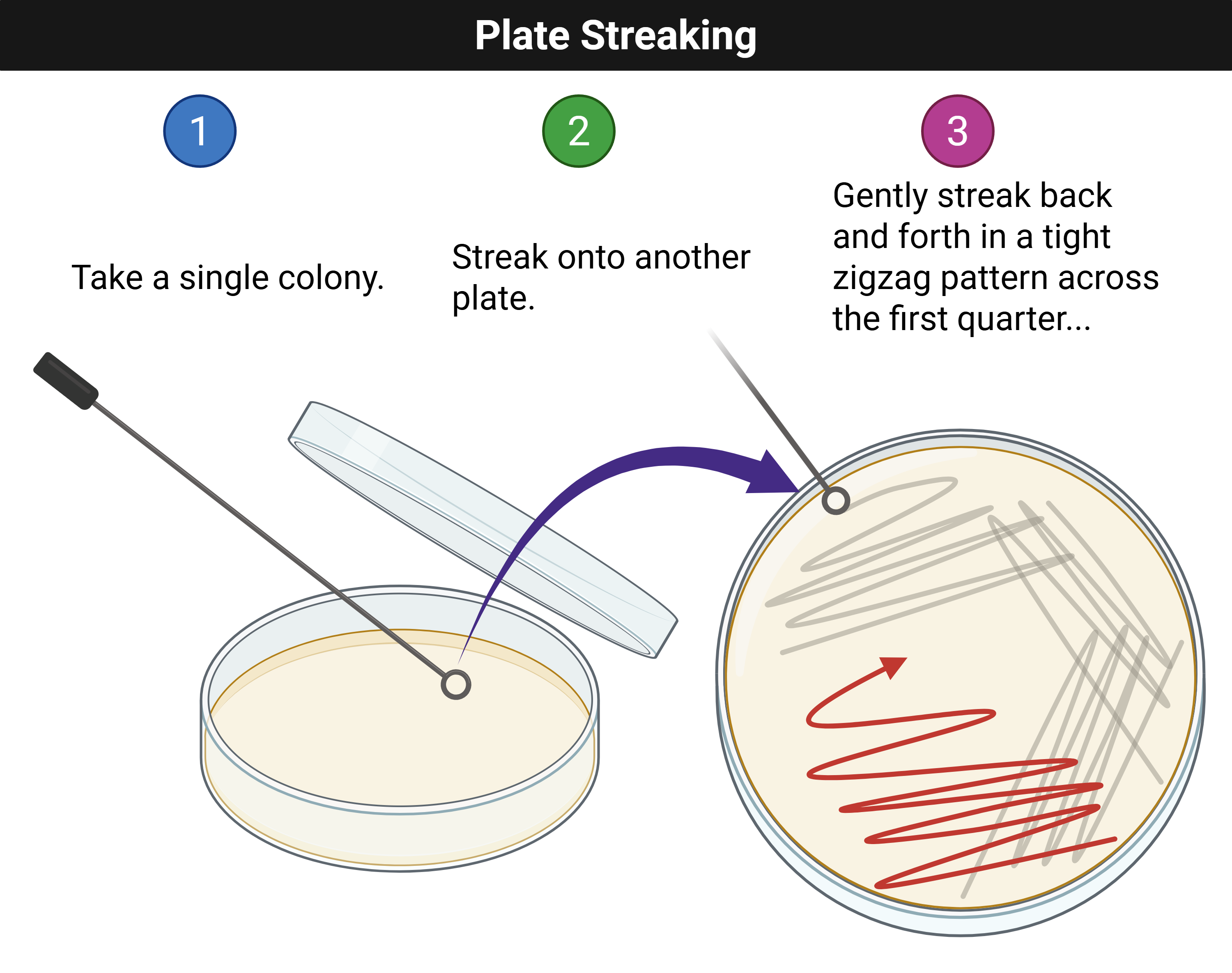
- Obtain a sterile loop. Do not touch the loop to any other surface
- Open the plate slightly and pick a single colony
- Streak onto a fresh TSA plate
- Close and label the plate with name, class, and date
Remember to label your plates with enough information for someone to understand what is growing and since when!
2.8.4 Methods: Plate Labeling
Figure Figure 2.2 shows the correct placement and content of labels on the bottom of an agar plate.
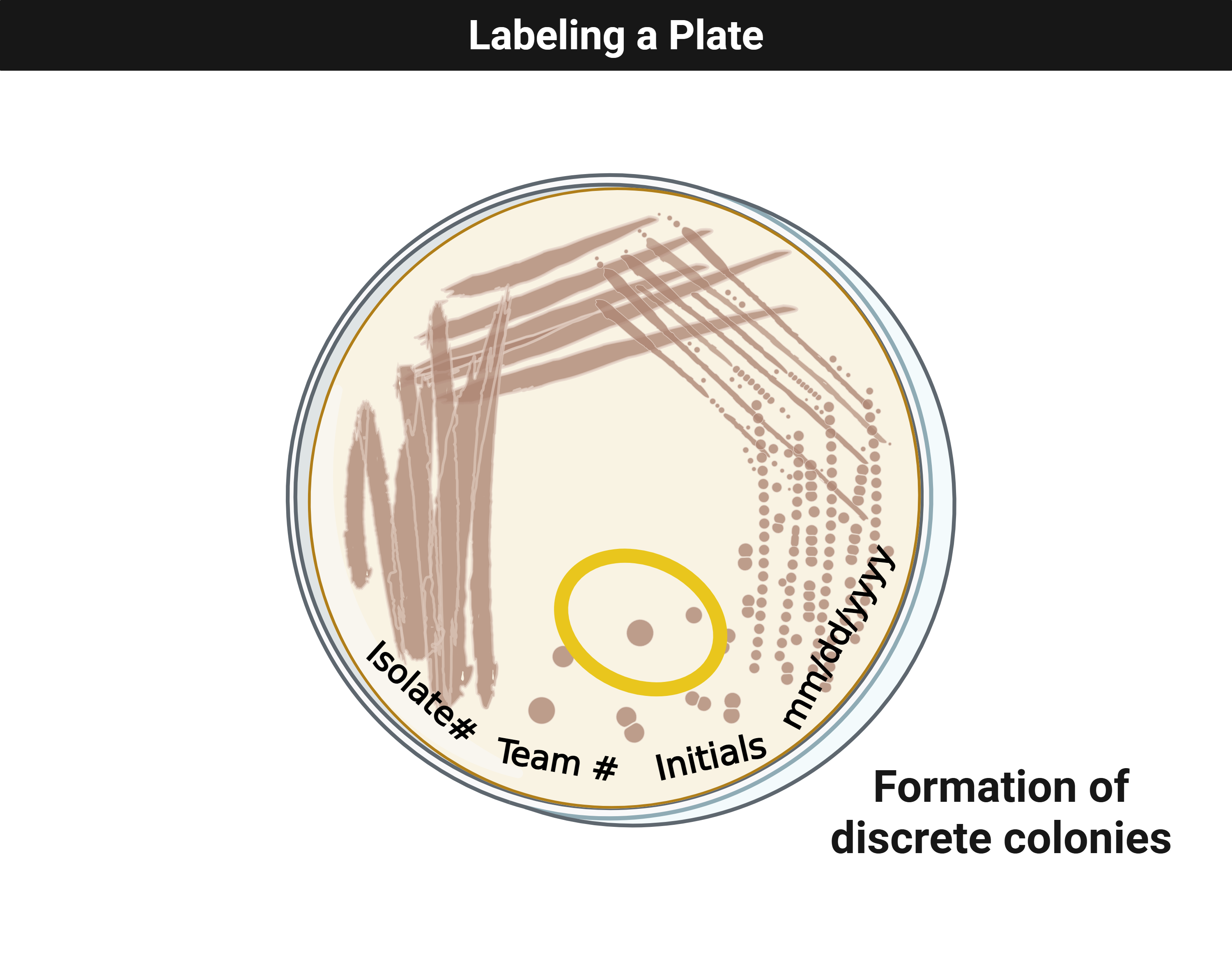
- Write on the bottom of the plate with a permanent marker.
- Include your isolate name, class section, group number, and the date.
- Keep labels near the edge so they do not obscure the agar surface.
- Photograph the labeled bottom for your ELN record.
2.8.5 Methods: Starting a Liquid Culture
Obtain a 50 mL tube with Tryptic Soy Broth (TSB) and sterile culture tubes.
Label three test tubes (one set per pair of scholars) as indicated below:
2.1. “TSB Control” and [current date and your initials]
2.2. [The name of your isolate] and [current date and your initials]
2.3. Delftia acidovorans SPH-1 and [current date and your initials]
Use a sterile loop to obtain a colony and, without touching it to any surface, use one hand to open the test tube slightly and the other to swirl the loop with bacteria in the medium.
Work quickly and carefully to avoid contamination.
Do not leave the rich media exposed to potential microbial contamination!
Confirm that the tubes are labeled and capped to the first stop - the caps will jiggle a little but not come off. This is ok!
Place the tubes in the shaking incubator set to 30°C.
We will incubate with shaking for 24 hrs.
Next session, we will repeat and grow without shaking to compare.
2.9 Data
Record observations of colony morphology:
- Color
- Size range
- Shape
- Edges
- Texture or sheen
- Other observations
Liquid culture setup - Tube labels used - Inoculation notes - Shaking versus static plan - Start time
2.10 Results
Replace the note with the description of the results obtained. Paste images of the original TSA plate, streaked TSA plate, and liquid culture tubes. Add short captions and describe what you observed
2.11 Result Analysis
Write an analysis of your results; explain what these results mean, and whether this matches what was expected:
2.12 Discussion
If a student touched the agar with a thumb and unexpected colonies appeared later, what was the likely source of contamination and how could it have been prevented?
What differences would you predict between static and shaking liquid growth?
Replace the note with your discussion.
2.13 Reflection
- What worked well?
- What challenges did you encounter?
- What would you change next time?
- What is one question you still have?
Replace the note with your Reflection.