3 Module 3: Microbial Growth Curves
3.1 Background
This module compares growth and biofilm formation in Delftia acidovorans, Delftia tsuruhatensis, and student isolates while maintaining strong contamination control.
3.2 Criteria for Success
Successful completion requires participation in both assay workflows, collection of analyzable data, and a complete ELN entry.
3.3 Learning Outcomes
- List safety considerations for propagating microbes. (CO 3, 4, 5) 🥼
- Explain the differences between static and shaking growth. (CO 3, 4, 5) 🥼
- Describe the features of biofilms. (CO 5) 🥼
- Discuss the significance of growth curves. (CO 3, 4, 5) 🥼
- Practice using a multichannel. (CO 3, 4, 5) 🥼
- Practice diluting an overnight culture and consistently seeding 96-well plates without contamination. (CO 3, 4, 5) 🥼
- Describe the purpose, methods, and preliminary results of your microbial propagation experiments. (CO 3, 8) 📁
- Collect growth data and biofilm viability data. (CO 6, 8) 📈
- Interpret growth data and biofilm data. (CO 8, 8) 📈
- Create an annotated bibliography (five or more sources). (CO 3) 🏅
3.4 Skills and Knowledge
Completing this module will help you develop and practice the following skills and knowledge, which you can include in your curriculum vitae.
Skills: The purpose of this module is to help you practice the following skills that are essential to safe and effective lab work with microbial isolates.
- Working safely with liquid cultures in 96-well plates.
- Documenting lab work, including protocols and results.
- Interpreting growth curve and biofilm data.
- Propagating bacteria in liquid cultures.
Knowledge: This module will also help you become familiar with the following important content in microbial genomics lab settings:
- Understanding PPE requirements for microbial work.
- Familiarity with the propagation of microorganisms in liquid media.
- Seeding of 96-well plates for bacterial growth and biofilm analyses.
3.5 Procedures
3.5.1 Lab Safety
3.5.1.1 Before Lab:
- Wear the correct PPE (lab coat, goggles, and gloves).
- Wipe the lab bench with 70% ethanol.
- Before working with microorganisms, carefully wipe pipettors with 70% ethanol.
3.5.1.2 During Lab:
- Treat all tips as potential biohazards.
- Remove your PPE if you are leaving the lab (water/bio break).
- Discard samples and disposable lab items in the correct trash bins.
- Try to keep personal items (computers, phones, etc.) usage to a minimum.
3.5.1.3 After Lab:
- Wipe your station with 70% alcohol.
- If you touched any personal items during the lab, wipe them with 70% ethanol before leaving.
- Dispose of gloves in the main biohazard waste container.
- Dispose of used petri dishes in the biohazard bin.
- All liquids containing bacteria must be poured into a beaker for bleach decontamination (can be found on the blue bench paper by this sink labeled “liquid”).
- Glass tubes can be placed into a beaker (on the blue bench paper by this sink, labeled “glass”).
- All bacterial growth plates can be thrown away in the biohazard trash.
- Return all reusable materials to our storage drawers.
- Wipe down all surfaces with ethanol.
- Remove PPE.
- Wash your hands.
3.5.2 Methods: Liquid Culture Setup
- Isolated colonies of your bacteria were picked and transferred to a liquid culture medium.
- Inoculated liquid culture tubes were placed in a shaker at 30°C (degrees Celsius) overnight with shaking (200-250 RPM).
3.5.3 Methods: Growth Assay Setup
- For growth curves, obtain your overnight cultures and prepare 1:1000 dilutions as follows:
- 25 µl of overnight culture into 25 ml of fresh TSB prepared for you for your positive control (Delftia acidovorans SPH-1) and your isolate.
- 25 µl of the overnight TSB control into 25 ml of fresh TSB prepared for you as your negative control
Mix each 50 mL conical tube by inverting several times and vortexing.
Carefully pour your diluted cultures into a white plastic sterile reservoir.
Use one plastic reservoir for the positive control and use a separate one for the negative control
Prepare your plastic reservoir when you are ready to use it to avoid contamination!
With a multichannel set to 100 ul, take 8 p200 tips and pipette 100 µl of culture into columns of a 96-well plate as follows. Keep the plate covered with the lid whenever possible to prevent contamination.
Review the protocol changes in the Slides for Module 3. Follow the protocol on the slides to add your isolate to the correct columns.
Figure Figure 3.1 provides a reusable 96-well template for mapping control wells and isolate conditions before loading the plate.
.png)
- Carefully seal the plate using Breathe-Easy seals to allow exchange of oxygen, carbon dioxide, and water vapors while preventing microbial/viral contamination and well-to-well cross-contamination. Follow this video on how to use Breathe-Easy:
- Label the side of the plate with your team name, group number, Delftia isolate, and date.
- Gently place the plate in the Agilent LogPhase600 plate reader, verifying that position A1 is on the top right. Ensure it is locked into position.
- Note the position (1-4) of your plate and wait for the instructors to start growth curves at 30°C with shaking for 48 hours.
- Instructors will share with you the spreadsheet with absorbance readings at 600 nm and time points when the run finishes.
3.5.4 Methods: Biofilm Assay Setup
For biofilm formation and viability, we will use the Dojindo Biofilm Viability Assay B603:
- For “seeding” your plate, take your overnight cultures and prepare 1:1000 dilutions as follows:
25 µl of overnight culture into 25 ml of fresh TSB prepared for you for your positive control (Delftia acidovorans SPH-1) and your isolate.
25 µl of the overnight TSB control into 25 ml of fresh TSB prepared for you as your negative control
Mix each 50 mL conical tube by inverting several times and vortexing.
Carefully pour your diluted culture into a white plastic sterile reservoir.
Use one plastic reservoir for the positive control and use a separate one for the negative control
Prepare your plastic reservoir when you are ready to use it to avoid contamination!
With a multichannel set to 180 µl, take 8 p200 tips and pipette 100 ul of culture into columns of a 96-well plate as follows. Keep the plate covered with the lid whenever possible to prevent contamination.
Columns 1 and 12 will receive TSB alone - pipette last to minimize contamination
Columns 2, 3, 4, 5, and 6 will receive TSB + Delftia acidovorans SPH-1
Columns 7, 8, 9, 10, and 11 will receive your TSB + Delftia isolate.
Carefully open a peg-lid container, ensuring the pegs do not touch surfaces.
Place the lid on the plate, submerging all pegs into the cultures and TSB.
Label the side of the plate with your team name, group number, Delftia isolate, and date.
Place the plate in the appropriate incubator, verifying that position A1 is on the top right.
Check that the temperature is set to 30°C.
We will remove the plate after 48 hours to wash the pegs and perform a viability stain as described below.
3.5.5 Methods: Biofilm Viability
Figure Figure 3.2 outlines the wash-and-detection workflow used to measure biofilm viability after incubation.
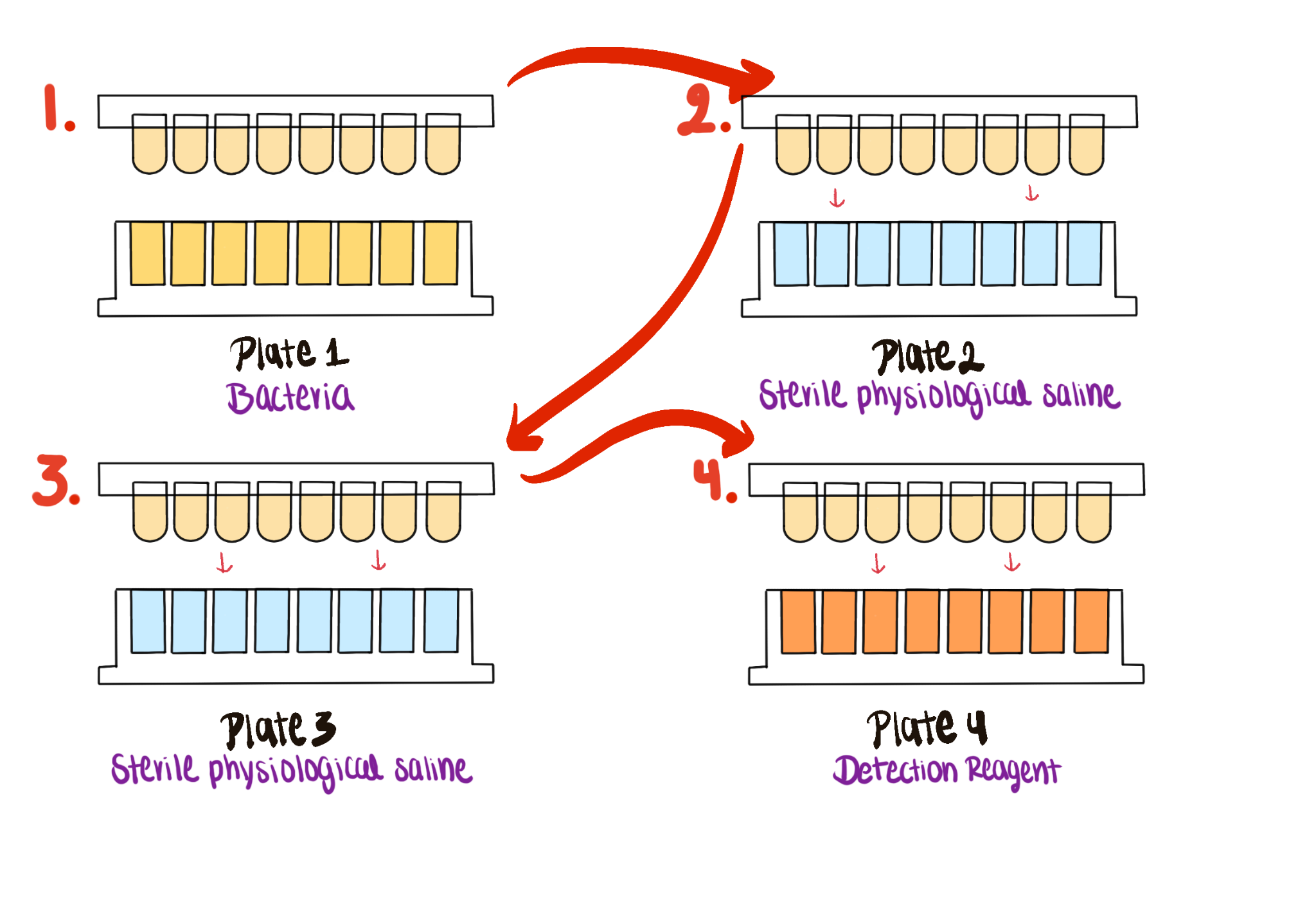
- Label new plates as: Plate 2, Plate 3, and Plate 4.
- Add 200 μl of sterile physiological saline (PBS) solution to each well of 96-well Plate 2 and 96-well Plate 3.
- Wash the 96-peg lid from your plate with bacteria by soaking it in 96-well plates 2 and 3
✨Important: Please soak the lid in saline gently and avoid vigorous shaking. The incubation time for coloration depends on the species of microorganism and the test substance.
- Mix 990 μl of WST Solution and 110 μl of Electron Mediator Reagent in a conical tube, and add 20.9 ml of Tryptic Soy Broth (TSB) to prepare the detection reagent.
- Carefully and accurately fill each well of Plate 4 with 200 μl of the detection reagent.
- Place the 96-peg lid onto 96-well Plate 4 and incubate the plate at 37°C.
- Remove the 96-peg Lid and measure the absorbance at 450 nm with a microplate reader.
3.5.6 Methods: Growth Curves
- Save your raw data and share it with your group. The spreadsheet includes readings at every time point for your plate.
- Upload the text file to your repository for analysis.
- Plot growth curves for your plate and compare each well and isolate.
3.5.7 Methods: Biofilm Viability Data Analysis
- Save your raw data and share it with your group. The spreadsheet includes absorbance values for each well after using the WST assay, which produces a color change when cells are metabolically active.
- Duplicate the spreadsheet to create a copy you can edit and format for your calculations.
- Calculate the average absorbance for your negative (TSB only) controls.
- Subtract the average TSB-only absorbance from all wells: this is your background absorbance.
- Now calculate the average absorbance for each column of background-corrected absorbance values.
- Calculate the standard deviation for each column of background-corrected absorbance values.
- Plot the average absorbance for each column and then compare the average growth for each isolate.
3.6 Data/Results
Run the code with your data to produce the results and charts necessary for results analysis.
3.7 Result Analysis
Write an analysis of your results; explain what these results mean, and if this matches what was expected
3.8 Discussion
Biofilms are notoriously difficult to eliminate and often require physical removal. In many cases, however, physical removal isn’t possible, and antibiotics are surprisingly ineffective. What makes biofilms so tough? Explain how their structure and behavior help them survive antibiotic treatment!
What results would you expect from your growth curve?
Write your answers to the questions above here