5 Module 5: Microbial Interactions
5.1 Background
After characterizing individual growth and metabolism, this module asks how isolates behave in the presence of other organisms. The Cerillo Duet co-culture platform allows isolates to grow in adjacent chambers separated by a membrane that permits exchange of metabolites without direct mixing of cells.
5.2 Criteria for success
As scientists, we should strive for specificity and accuracy. To complete this module, you will need to participate in the in-lab activities, complete the co-culture assay setup tasks, obtain data to analyze, and complete your lab entry as described.
5.3 Learning Outcomes
- List safety considerations for propagating microbes. (CO 3, 4, 5) 🥼
- Explain the purpose of the Duet wells/plates and co-culture assays. (CO 3, 4, 5) 🥼
- Discuss the significance of microbial fluid interactions. (CO 3, 4, 5) 🥼
- Practice diluting cultures to a desired value. (CO 3, 4, 5) 🥼
- Practice consistently seeding wells without contamination. (CO 3, 4, 5) 🥼
- Describe the purpose, methods, and preliminary results of your Duet Co-culture experiments. (CO 3, 8, 2,9) 📁
- Collect co-culture growth data. (CO 6, 8) 📈
- Interpret growth data from Duet co-culture plates. (CO 8, 6,7) 📈
- Revise the draft for your individual and group projects. (CO 3, 9) 🏅
- Analyze how this experiment contributes to your overall experimental goal. (CO 1) 🤔
5.4 Skills and Knowledge
Completing this module will help you develop and practice the following skills and knowledge, which you can include in your curriculum vitae.
Skills: This module helps you practice the following essential skills for safe and effective lab work with microbial isolates. Additionally, you will learn to generate, visualize, and analyze bacterial co-culture data. After completing this lab, you will gain the following lab skills:
- Lab safety and proper personal protective equipment (PPE)
- Proper use of Cerillo’s vertical membrane co-culture and pipettors
- Analysis of growth data for co-cultures
Knowledge: This module will also help you become familiar with the following important content in microbial genomics lab settings:
- Understanding PPE requirements for microbial work.
- Familiarity with co-cultures and growth assessment.
- Understanding microbial interactions.
5.5 Procedures
5.5.1 Lab Safety
5.5.1.1 Before Lab
- Wear the correct PPE (lab coat, goggles, and gloves).
- Wipe the lab bench with 70% ethanol.
- Before working with microorganisms, carefully wipe pipettors with 70% ethanol.
5.5.1.2 During Lab
- Treat all tips as potential biohazards.
- Remove your PPE if you are leaving the lab (water/bio break).
- Discard samples and disposable lab items in the correct trash bins.
- Try to keep personal items (computers, phones, etc.) usage to a minimum.
5.5.1.3 After Lab:
- Wipe your station with 70% alcohol.
- If you touched any personal items during the lab, wipe them with 70% ethanol before leaving.
- Dispose of gloves in the main biohazard waste container.
- Dispose of used petri dishes in the biohazard bin.
- All liquids containing bacteria must be poured into a beaker for bleach decontamination (can be found on the blue bench paper by this sink labeled “liquid”).
- Glass tubes can be placed into a beaker (on the blue bench paper by this sink, labeled “glass”).
- All bacterial growth plates can be thrown away in the biohazard trash.
- Return all reusable materials to our storage drawers.
- Wipe down all surfaces with ethanol.
- Remove PPE.
- Wash your hands.
5.5.1.4 Methods
What Was Prepared in Advance:
- Start an overnight culture of your isolate in Tryptic Soy Broth (TSB, 2.5 mL per tube) by using a sterile loop to obtain one colony from an agar plate and inoculate TSB.
- Incubate with shaking at 30°C overnight.
5.5.1.5 Methods: Day of the Lab
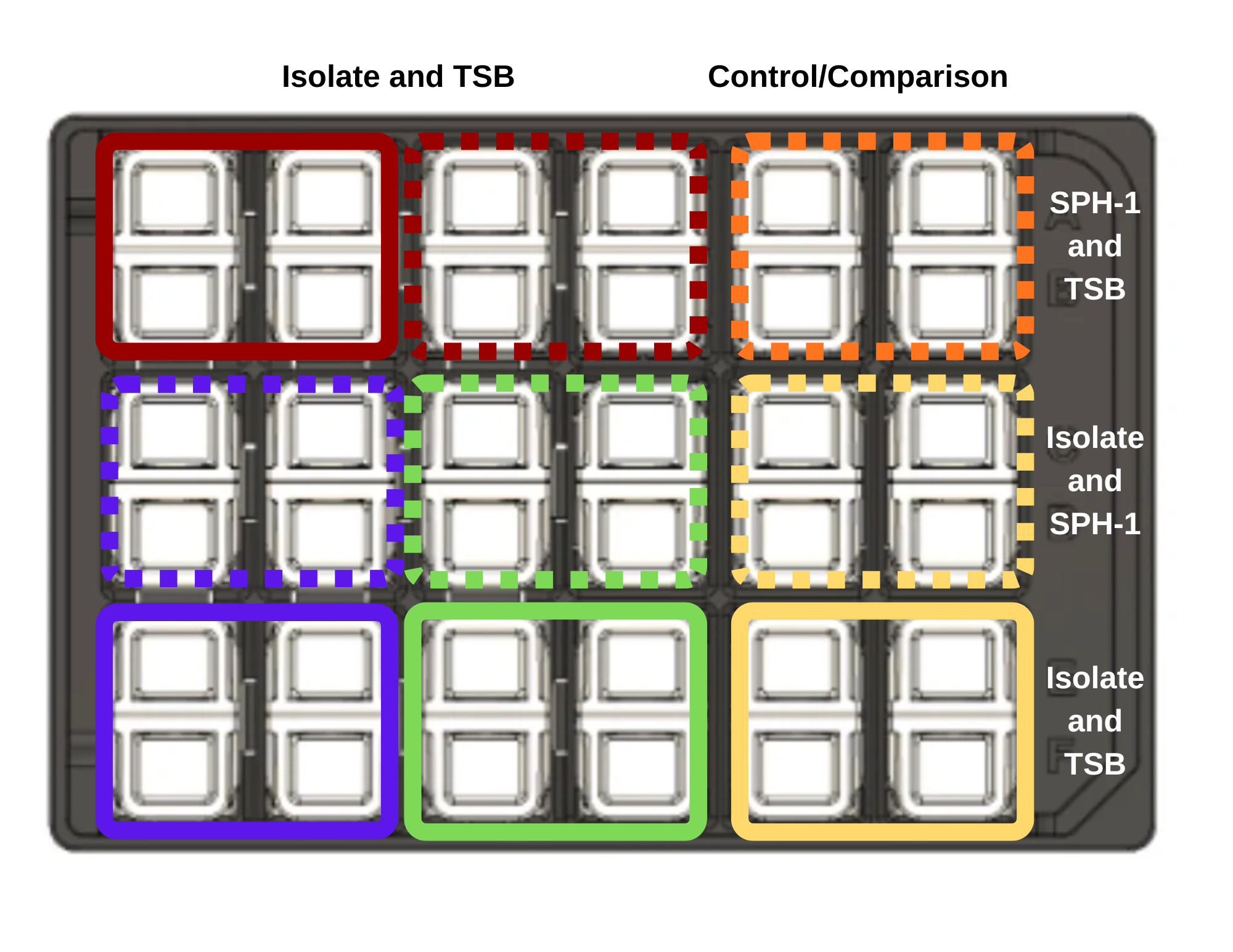
Figure Figure 5.1 maps the isolate-only, control, and co-culture conditions across the Cerillo Duet platform.
- Obtain your liquid culture and dilute it 1:1000 into fresh Tryptic Soy Broth in a 15 mL tube with 10 mL of TSB.
- For a 1:1000 dilution, you will need 10 mL of TSB and 10 µL of liquid culture.
- Carefully pipette 800 µl of your diluted culture into triplicate wells.
- Add 800 µl of TSB to the adjacent wells. These will be your growth controls.
- Carefully pipette 800 µl of your diluted culture into triplicate wells.
- Add 800 µL of 1:1000-diluted SPH-1. These will be your co-culture experimental assays.
Work carefully to prevent cross-contamination of wells.
Once all wells are prepared, carefully seal the co-culture wells with sealing tape.
Incubate with shaking at 30°C for 24-48 hours.
OD measurements were recorded at 600 nm every 5 minutes. All experiments will be conducted in triplicate, with biological replicates.
Obtain your data to plot and analyze growth curves.
5.6 Data/ Results
Paste a picture of your plate and any figures or images generated from your data:
Replace the note with your results, add images if applicable.
5.7 Result Analysis
Compare isolate-only growth to co-culture growth. Explain whether the second organism appeared to support, suppress, or otherwise reshape your isolate’s growth profile.
Replace the note with your result analysis.
5.8 Discussion
In which ways are co-cultures beneficial for research? Think about what co-cultures can tell us about an organism and its interactions with others.
What factors can affect the growth of an organism? If your organism thrived in co-culture, what kind of beneficial metabolites might be diffusing across that membrane to help it thrive? If your organism did not thrive in co-culture, what metabolites/resources might be shared between both organisms?
Identify at least one change made to the lab protocol, whether intentional or accidental (e.g., wrong amount of reagent used, contamination, etc). How did, or could, this change/accident impact your final results?
Replace the note with your discussion.